National Preparedness Month - What's Your Lasting Legacy?
Each September, FEMA raises awareness about the importance of preparing for disasters. We know they could happen at any time. Is your organization ready?
This month, National Preparedness Month encourages individuals and organizations to build a lasting legacy by protecting what you’ve built. Taking the first steps to becoming prepared for disaster. If you haven’t already, take that time to re-examine and strengthen the cybersecurity strategies at your organization.
You may be wondering if your small business needs a robust cybersecurity and disaster recovery strategy. The truth is, you do — businesses of all sizes and all industries are at risk.
In fact, the 2021 Verizon Data Breach Investigations Report found that 1 out of every 5 data breach victims were small businesses. What’s more, small businesses that experienced a data breach — from cybercrime or other disaster — lost an average of $21,659. That’s a challenging loss that many small businesses would have a difficult time recovering from.
While cybersecurity threats are not 100% preventable, there are many key steps your business can take to develop a stronger security posture. It’s also important to understand the types of cybersecurity threats that are most prevalent today. Continue reading to learn more about these threats and what your business can do to stay ahead of hackers.
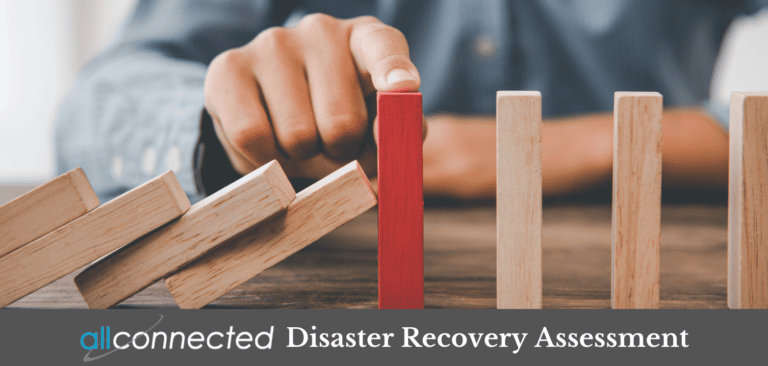
You can also click the image below to take our Disaster Recovery Assessment. This will help you determine your DR readiness by rating yourself on a scale from 1 to 4 on 9 topics, including a chart at the end to review your answers.
While there are certain security threats that may be more prevalent in your industry, there are several common ones to watch out for. We recommend familiarizing and educating yourself and your team members on the following threats:
Ransomware: This type of attack can happen in different forms, but it always locks you out of your systems or data and requires a payment to be made in order to gain access again. Hackers do this by using email spam, malicious links, or phishing to encrypt your devices, networks, and/or data. The most common example involved the Colonial Pipeline attack when hackers demanded over $5 million in ransom. Learn more
Social Engineering: Arguably one of the most dangerous cyberattack techniques, social engineering involves psychologically manipulating you or your team members to release compromising information. Hackers will do this by posing as someone “trustworthy” such as an employee, a financial institution, or even a friend. Email impersonation is a common example.
Third-Party Access: Many organizations utilize third-party software and applications to run their business. How are programs or applications protected? Oftentimes, they aren’t adequately secure, which leaves your business more vulnerable to attacks.
As we mentioned, there is no single security strategy or method that will completely prevent cyberattacks. Instead, we recommend implementing a multi-layered security strategy to adequately protect your assets. It’s also important to develop a clear data recovery plan in the event a cyberattack occurs.
Here are a few additional steps you can take to secure your business:
Identify Your Risks and Develop a Plan: Start by identifying your organization’s unique security risks. This may be dependent on the size of your business or the industry you’re involved in. The NIST Cybersecurity framework is a great reference point for identifying “systems, people, assets, data, and capabilities” that put your business at a greater cybersecurity risk.
Enable Multi-Factor Authentication (MFA): This is a simple strategy that works — in fact, Microsoft found that MFA can prevent 99% of hackers. MFA involves adding an additional layer of security that requires you to provide two or more verification factors to use an online application, account, or a VPN. Rather than just entering your password, MFA prompts you to enter additional information, such as a PIN, a confirmation on your smartphone, or even a fingerprint.
Utilize Email Spam Filtering: Ransomware and social engineering attacks often occur via email — in fact, 94% of small businesses detected malware by email. Ensure you have strong anti-spam filtering and malware detection in place to prevent these attacks from happening.
Evaluate Your Cloud Security: It’s easy to assume that all cloud services are automatically protected from external threats, but that’s not the case. Cloud security attacks have increased over the years and will only continue to do so. If your business uses the cloud in any way, ensure your data is protected.
Implement Data Back-Ups and Recovery: A strong security posture wouldn’t be complete without a data back-up and recovery strategy, as well as threat detection methods. These strategies not only prepare your business in the event a security breach occurs, they also allow artificial intelligence (AI) and dedicated network security analysts to discover, analyze, and remediate security breaches before cybercriminals attack. Learn more
Consider AllConnected's Suite of Services
Security and Disaster Recovery can be challenging and complex to understand. That’s why AllConnected is here to help. We offer a comprehensive suite of IT Solutions to ensure your business, employees, and extended teams stay secure, infrastructure remains available, and data and applications are always protected. This includes a variety of services such as cybersecurity assessments, email security, cybersecurity training, DNS security, managed detection and response, and much more.
Contact us today to get started on improving your security posture and protecting your lasting legacy. We look forward to working with you.