
Many organizations wrestling with the new realities in our economy are moving to the cloud.
Why move to the cloud? On-premise infrastructure requires space, large capital expenditures with periodic refreshes and/or warranty renewals, heating, cooling, temperature monitoring, hardware and software updates, and physical on-site security and support.
In most cases, moving your infrastructure to the cloud (IaaS) means reduced costs along with increased flexibility, mobility, and versatility.
IT managed service providers like AllConnected may offer a variety of cloud options which will enable you to:
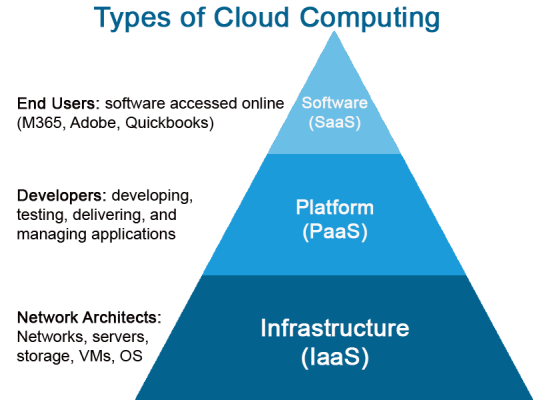
Cloud infrastructure options typically fall into one of three categories:
Software as a service (SaaS): You access this software online, rather than as a download, and use it on your local machine. Examples include any browser-based email service, Quickbooks, and Adobe Creative Cloud.
Platform as a service (PaaS): A complete cloud computing model offering hardware, software, and infrastructure services. Examples include Microsoft Azure and Google App Engine
Infrastructure as a service (IaaS): A set of computing, storing, and networking resources
To access these services, you have three primary Cloud Services options:
Providers like Microsoft, Amazon, and Google rent access, storage, usage, and computing resources over the Internet. They own and manage infrastructure, while you manage your own account, data, and applications on a “pay-as-you-go” basis, like a public utility.
Public clouds typically offer national or international coverage, along with standardized tools, security, and reporting.
Organizations and MSPs may offer exclusive computing resources in a private cloud physically located on the company’s on-site datacenter or in a remote datacenter.
In a private cloud, services and infrastructure are maintained on a private network, enabling organizations more complete control of their environment.
Hybrid clouds combine public and private cloud (or possibly on-premise storage), connected through technology that allows data and applications to be shared.
Hybrid environments provide greater flexibility for organizations with specific compliance requirements.

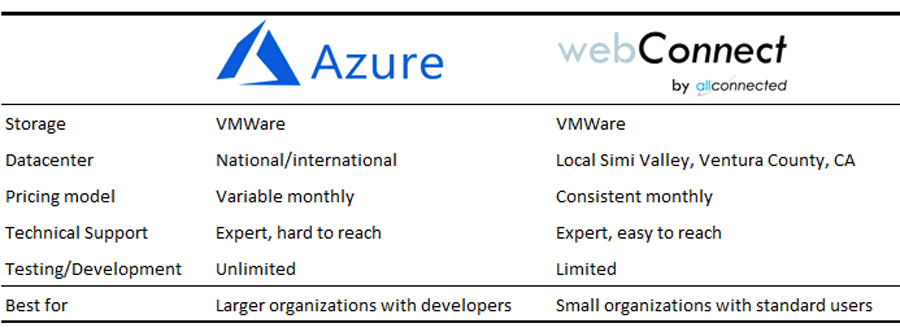
Microsoft Azure provides enterprise-grade virtual compute (VMs), networking, storage on the internet. It is a multi-tenant public cloud run on over 200 data centers in 50 regions around the world, with high level security to meet over 90 global compliance standards, including PCI-DSS, HIPPA, GDPR, ISO, and more. And with hundreds of internal functions, apps, and analytics, Azure is a great choice for small business public cloud.
Azure Active Directory (AD) solves a variety of IT security concerns if you want to maintain certain on-prem data for a hybrid cloud environment.
Azure also makes transitioning from on-prem to the cloud easier with Azure Hybrid Benefit, allowing your on-prem software assurance licenses for Windows Server and SQL Server to transfer to Azure.
Your organization could also achieve a “serverless infrastructure” using Azure AD to connect M365 to Salesforce, eliminating the need for anything but cloud compute and storage.
Azure’s “pay-as-you-go” pricing means you pay for what you need so that you can right-size your compute and storage needs. For example, financial organizations like H&R Block require more space and bandwidth around tax preparation time, so they can dial-up or dial-down space and bandwidth as needed.
While Azure has so much going for it, organizations still face certain challenges which include:
While some Azure considerations are expected and workable, the cloud service professionals at AllConnected felt that a private cloud alternative, webConnect, might be a better fit for some clients.
Designed for small business, webConnect offers VM-based private cloud services from our Simi Valley, CA facility at a predictable monthly cost. As mentioned, a private cloud environment can be customized to your organization’s specific needs, especially if that includes keeping your data local, and keeping your monthly operational expenses consistent.
While AllConnected does not provide as deep a bench as Microsoft, you can reach the tech configuring and maintaining your cloud environment, so you can talk through your needs and receive updates based on your service-level-agreement (SLA).
Other key benefits to webConnect:
Whichever option your organization needs — public, private, or hybrid — AllConnected can help. Our IT professionals can help you migrate and manage your cloud infrastructure so that your business is prepared, connected, and protected.